
Bathroom Shower Systems Explained: Overhead, Rain, Hand & Body Jet Compared

Choosing the wrong shower is an expensive mistake - one that's fixed in your walls before you realise it. Most homeowners spend weeks choosing tiles and minutes choosing their bathroom shower system, then discover mid-renovation that their building's water pressure can't support the rain shower they specified, or that their shower enclosure is 200mm (8 in) too small for body jets to function properly.
This guide covers every shower type, where the real distinctions lie, and how to match the right system to your bathroom before you commit.
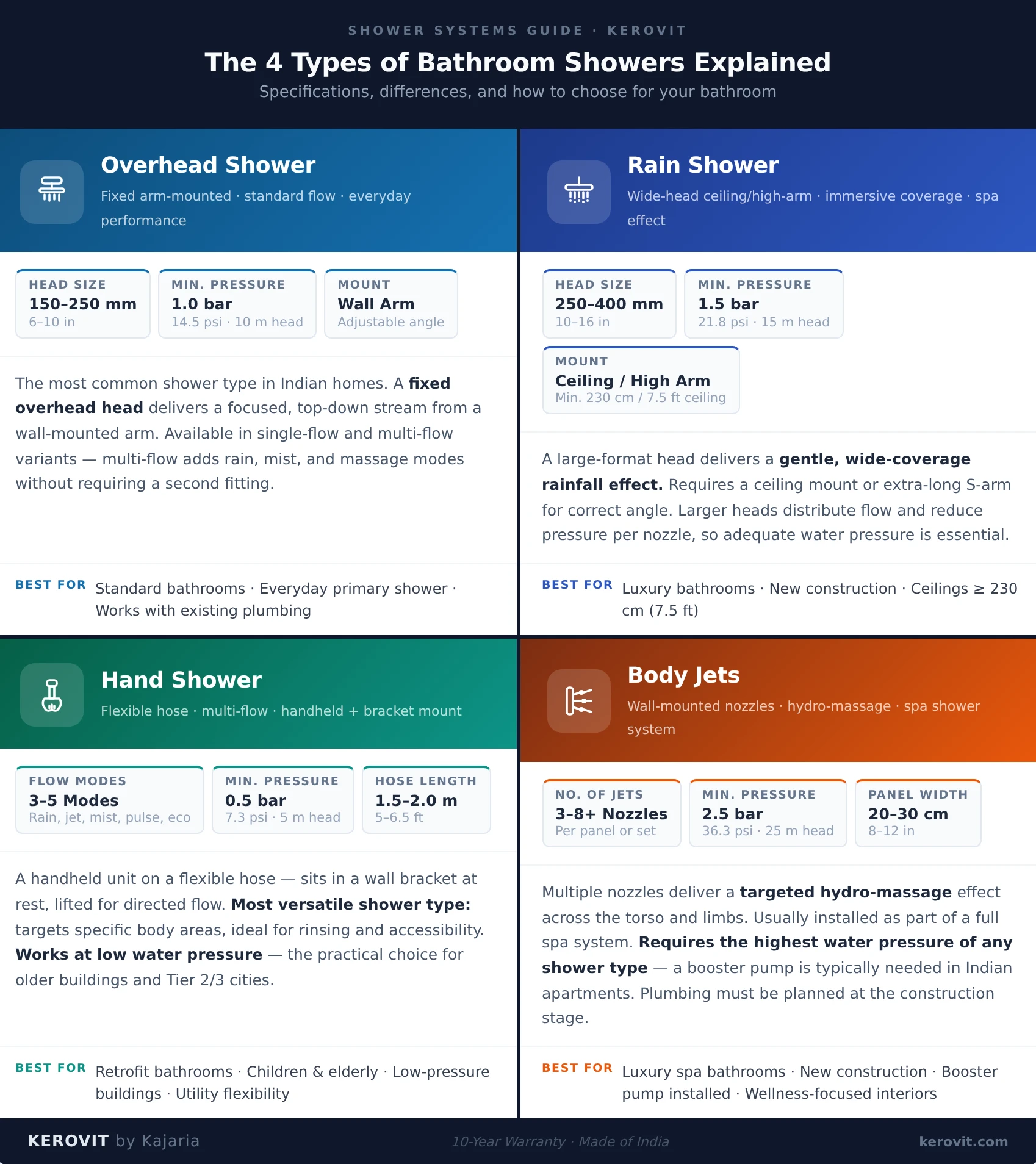
The Four Main Types of Bathroom Showers
Every shower configuration starts with understanding what each component does - and what it doesn't.
Overhead vs Rain Shower: Where the Real Difference Lies
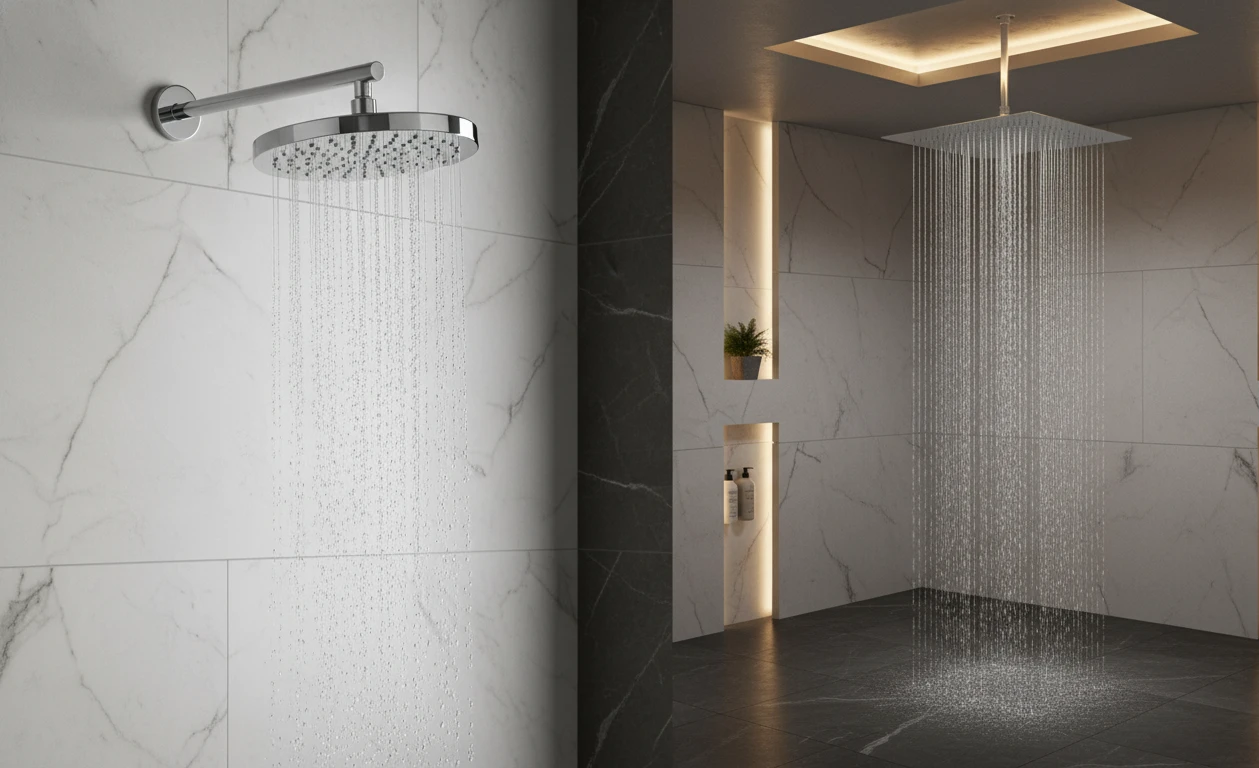
The practical difference between an overhead shower and a rain shower head extends beyond head size and spray pattern.
- Flow rate and pressure response: A standard overhead shower head is designed to perform at 8–12 litres per minute across varying pressure. Its focused spray channels water efficiently even when pressure dips. A ceiling rain shower is optimised for a specific pressure range - it looks and feels best at 1.5–3 bar with a flow rate of 12–20 litres per minute. At lower pressure, the rainfall curtain breaks into uneven streams, which is why many installations pair ceiling rain showers with a dedicated booster pump.
- Mounting position: A rain shower head is designed to be mounted directly overhead - flush with the ceiling or on a ceiling drop arm - so water falls vertically downward. Mounting the same head on a standard wall arm compromises both the aesthetic and the physics. If your bathroom cannot accommodate a ceiling arm (low ceiling height, structural constraints), an overhead shower on a wall arm will perform better and look correct.
- The practical recommendation for Indian apartments: In buildings with variable or low municipal supply pressure, a high-quality overhead shower in the 150–200mm range is the more reliable investment. A ceiling rain shower is an excellent upgrade when consistent pressure is available or when a booster pump is part of the renovation plan.
Hand Shower vs Body Shower: Different Roles, Not Just Different Styles
These two are frequently confused in product searches, but they serve distinct purposes in the shower system hierarchy.
A hand shower for bathroom use is a precision and flexibility tool. It doesn't compete with the overhead shower - it extends what a fixed shower head cannot do: rinse a specific area, help someone who can't stand for a full shower, or clean the shower space after use. A diverter valve lets you switch between overhead and hand shower modes through a single water outlet, making the combination cost-effective and practical.
Body jets are a full-system upgrade, not an add-on. They create an immersive hydromassage experience that no hand shower replicates, but they require their own dedicated water supply and a thermostatic valve with multiple outlets. The most common mistake in premium bathroom specifications: body jets added late in the design process, after plumbing is roughed in, requiring expensive rerouting. If you want body jets, they need to be specified at the point of plumbing - before walls close.
For the overwhelming majority of Indian homes, a well-chosen overhead shower paired with a hand shower represents the optimal balance of performance, flexibility, and installation complexity.
Shower System Combinations That Actually Work
Premium bathroom shower components are designed to work as systems. The most effective configurations for Indian homes:
- Overhead + Hand Shower (Single Diverter): The practical standard. One outlet, a diverter valve to switch between fixed and hand shower. Covers every daily use case. Suitable for all bathroom sizes and most pressure ranges.
- Rain Shower + Hand Shower (Two-Outlet Diverter): The upgrade for bathrooms with reliable pressure above 1.5 bar. The ceiling shower handles immersive bathing; the hand shower handles targeted tasks. Requires a two-outlet diverter or a thermostatic valve with dual outlets.
- Full Spa System (Rain + Hand + Body Jets): The configuration for dedicated wet zones in master bathrooms. Requires a thermostatic valve with three or more outlets, a booster pump in most Indian settings, and an enclosure of at least 1000mm × 1000mm. Plan the valve and plumbing layout first - the shower components follow from the valve capacity.
How to Choose the Right Shower System
Four variables drive the correct specification. Work through them in order.
1. Water pressure first. Before specifying any shower component beyond a basic overhead, measure your building's pressure or ask your plumber to test it. Below 1 bar: stick to overhead showers and hand showers. 1–1.5 bar: overhead shower plus hand shower is the ceiling without a pump. Above 1.5 bar: rain showers and multi-outlet systems become viable.
2. Enclosure dimensions. Body jets require minimum clearances to spray across the body at the correct angle. A shower enclosure under 900mm × 900mm (35 × 35 in) rules out body jets entirely. Map your component layout on paper before committing to the enclosure size.
3. User profile. A household with elderly members, young children, or anyone with limited mobility should prioritise a hand shower on an adjustable slide rail as a non-negotiable inclusion. Thermostatic control is strongly recommended in these households - it prevents sudden temperature spikes when pressure fluctuates.
4. Future-proofing the valve. A thermostatic valve costs more upfront but pays for itself over the system's lifetime: consistent temperature, protection against scalding, and the ability to add a third or fourth outlet if the shower is upgraded later. Specifying a two-outlet valve when a three-outlet valve costs marginally more is a common false economy.
Water Pressure & Water-Saving Tips for Indian Bathrooms
Water efficiency matters practically - not just on sustainability grounds. Indian cities face seasonal supply disruptions, and a shower system drawing 30 litres per minute empties a storage tank faster than most households account for.
- Built-in flow regulators: Look for shower heads with integrated flow regulators capped at 6–9 litres per minute. Premium shower heads achieve this while maintaining perceived pressure through spray design - wider spray plates, aerator-assist, and optimised perforation geometry. Always check the stated flow rate (LPM) in product specifications before purchase.
- Thermostatic valves reduce cold-water waste: Manual shower valves require waiting for temperature to stabilise before entering the shower. This pre-shower run wastes water on every use. A thermostatic mixer reaches its set temperature within seconds of opening the valve, cutting this waste entirely.
- Aerating hand showers: Many handshower heads use air-injection technology - mixing air with water to maintain spray volume sensation while reducing actual litres per minute. For households on water restrictions or with smaller storage tanks, aerator-equipped hand showers are worth specifying explicitly.
The Kerovit Shower Range
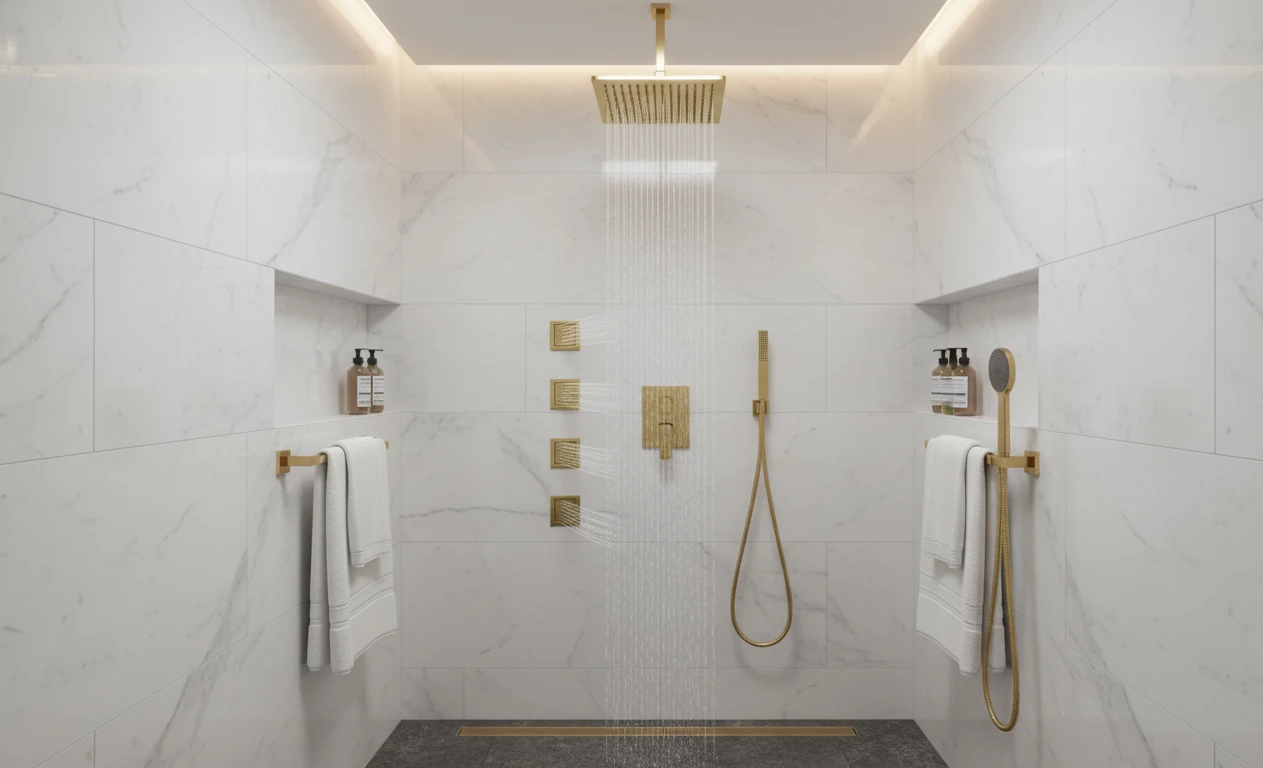
Kerovit's shower collection is built around this system architecture. The range covers overhead showers in single-flow, cascade, and multi-flow variants; ceiling rain shower heads designed for flush or ceiling-arm mounting; five-flow and single-flow hand showers; and body jets for full spa system installations.
For bathrooms where finish coordinates across every fitting, the Aurum PVD collection brings the complete shower range in gold, rose gold, and matte black - Physical Vapor Deposition finishes that resist tarnishing, corrosion, and the surface wear that chrome develops in humid environments over time. Every component in the range is backed by a 10-year warranty.
Explore the complete Kerovit shower range, and if you're specifying faucets alongside, the Kerovit premium tap collection is designed to coordinate finishes across the full bathroom - from basin to shower to bath spout.
Frequently Asked Questions
Q: What is the difference between an overhead shower and a rain shower head?
A: An overhead shower is any fixed above-head shower - the category. A rain shower head is a specific type: 200mm(8 in) or wider, designed to produce a broad, low-pressure rainfall cascade. Standard overhead showers work across a wider pressure range; rain shower heads need consistent pressure above 1.5 bar to perform as intended.
Q: Can a rain shower head be installed in a building with low water pressure?
A: Not effectively, without a booster pump. Rain shower heads distribute water across hundreds of perforations, which reduces pressure at each point. In low-pressure buildings, you get uneven trickle rather than a rainfall effect. Either install a pressure booster pump or specify a high-quality overhead shower instead.
Q: Do body jets need a separate valve from the overhead shower?
A: Yes. Body jets cannot share a standard single-outlet valve with an overhead shower - the combined flow demand requires a multi-outlet thermostatic valve. Running both from one valve results in inadequate pressure to both outlets simultaneously. Specify the valve capacity before finalising any spa shower layout.
Q: What is the difference between a hand shower and a body shower?
A: A hand shower is a handheld, flexible-hose shower head used for targeted rinsing and precision tasks. Body showers (body jets) are fixed wall nozzles that spray horizontally at body height for a full immersive experience. They serve different functions and are typically used together in a full spa system, not interchangeably.
Q: Is a thermostatic shower valve worth the extra cost?
A: For any multi-outlet shower system, yes - unequivocally. Thermostatic valves maintain set temperature regardless of pressure fluctuations, prevent scalding when another tap opens elsewhere in the building, and reduce water waste during warm-up. For single-outlet showers in households with elderly or young users, they're equally recommended for safety alone.
Conclusion
The most common shower system mistake isn't choosing the wrong head - it's choosing the right head for the wrong building. Check your water pressure before specifying a rain shower. Plan body jets at the plumbing stage, not after walls are tiled. And build around a thermostatic valve if your system has more than one outlet.
A well-specified overhead shower paired with a hand shower on a slide rail handles 95% of daily use in any Indian home. Everything beyond that is a genuine upgrade - as long as the plumbing and pressure can support it.
Explore the Kerovit shower range and build your system from the valve out.