
How Dual Flush Toilets Save Water (And Money) in Indian Homes
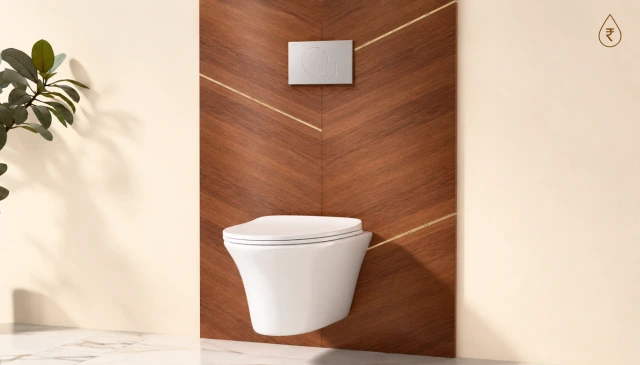
A traditional single-flush toilet can use 8-10 litres of water every time it's flushed - regardless of whether it's clearing liquid or solid waste. A dual flush toilet fixes that mismatch by giving you a choice, and across a household that adds up fast. Here's what actually happens inside a dual flush cistern, and what the water savings look like in practice.
What Is a Dual Flush Toilet and How Does It Work?
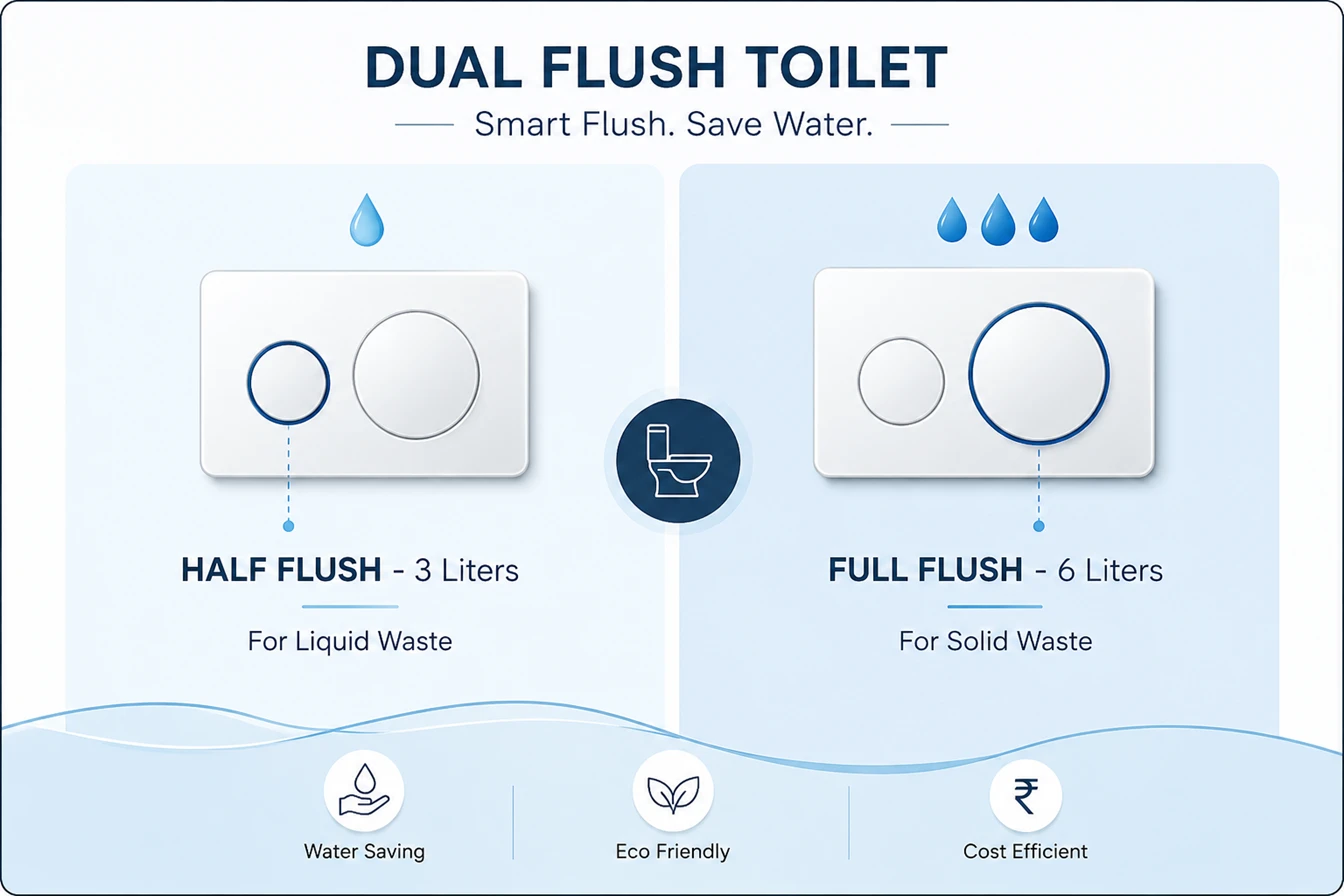
A dual flush toilet has two flush volumes controlled by separate buttons or a split-lever mechanism on the same flush plate - one for liquid waste, one for solid waste. Internally, the cistern uses a valve system that releases a smaller water volume for the half flush and a larger volume for the full flush, rather than emptying the entire tank every time the way older single-flush systems do.
This design didn't exist in most Indian bathrooms a generation ago. Older gravity-fed cisterns were built to empty completely on every flush, typically discharging 8-10 litres (2.1–2.6 gallons) regardless of what needed clearing. A dual flush system
changes that default - the tank still holds enough water for a full flush, but you only draw down the amount actually needed for lighter use.
The mechanism sits inside a concealed or exposed cistern connected to any western toilet - one-piece, wall hung, or floor-mounted - so the water savings aren't tied to a specific toilet style.
Full Flush vs Half Flush: When to Use Which
The rule of thumb is straightforward: half flush for liquid waste, full flush for solid waste. Most dual flush cisterns in India are calibrated to the Bureau of Indian Standards' specification for flushing cisterns (IS 774:2022), which can be customized 4 litres (1.1 gal) full flush, 2 litres (0.5 gal) half flush.
In everyday use, the half flush button clears the bowl adequately for liquid waste in the vast majority of cases - it's built to handle that load, not to under-perform it. The full flush exists specifically for solid waste, where the higher volume and flow rate are needed to clear the trap effectively. Using full flush by default, out of habit from single-flush toilets, is the single biggest reason households don't see the water savings a dual flush system is designed to deliver.
How Many Litres You Actually Save Per Flush
The gap between old and new is significant. Against a legacy single-flush toilet using 8–10 litres per flush, a standard dual flush system draws as little as 4 litres on full flush and roughly half that on half flush. The Ministry of Housing and Urban Affairs' guidance on water-efficient plumbing fixtures notes that dual flush arrangements can cut flushing water use by around 40%, with some configurations saving up to 75% compared to older fixtures.
Per flush, that's typically a saving of 6–9 litres (1.6–2.4 gal) whenever the half flush option is used instead of a full single flush. It's a small number in isolation - the impact shows up in aggregate, across every member of a household, every day, for years.
What This Adds Up to on Your Water Bill
To put this in perspective: take a household of four, averaging roughly five flushes per person per day, with about 70% of those being half-flush (liquid waste) use. Using 3 litres for a half flush and 6 litres for a full flush against an old single-flush baseline of 10 litres, the daily water use drops from roughly 200 litres to around 80 litres for toilet flushing alone - a saving in the range of 40,000–45,000 litres a year.
This is an illustrative calculation based on stated assumptions, not a guaranteed figure - actual savings depend on household size, flush frequency, and the exact cistern model installed. Water is billed differently across Indian cities and often in slabs, so a national average bill-saving figure isn't reliable without that local input.
How Dual Flush Toilets Align With India's Water Conservation Push
Dual flush isn't just a manufacturer feature - it's backed by national policy. The Bureau of Indian Standards' plumbing product standards cover flushing cisterns including dual-flush designs, and the Ministry of Housing and Urban Affairs recommends dual flush toilets as a water-efficient fixture alongside low-flow showerheads and faucet aerators.
Several states and municipal utilities go further, with building rules or rebate schemes favouring water-efficient fixtures - these vary by location, so it's worth checking your state or city water authority's current scheme rather than assuming a single national rule applies.
For homeowners, the takeaway is simple: dual flush isn't a niche add-on - it's where plumbing codes and water utilities are heading. Choosing a Dual Flush Toilet: Kerovit's Range Kerovit's western toilets - including one-piece models and wall hung toilet seat designs with concealed cisterns - are available with dual flush mechanisms across the range, so the choice of toilet style doesn't have to come at the expense of water efficiency. For bathrooms prioritising a compact, floor-clearing look, a wall hung toilet seat installation pairs naturally with a dual flush concealed cistern, since both are typically planned into the wall at the same stage.
If you're still weighing which format suits your bathroom, our guide on wall hung vs floor mounted toilets covers the layout trade-offs in more detail. Explore Kerovit's full toilet and sanitaryware range to compare dual flush options across styles.
Frequently Asked Questions
Q: How much water does a dual flush toilet actually save compared to a single flush toilet?
A: Against an older single-flush toilet using 8-10 litres (2.1–2.6 gal) per flush, dual flush systems typically use 4–6 litres (1.1–1.6 gal) on full flush and 2–3 litres (0.5–0.8 gal) on half flush - a meaningful reduction per use.
Q: Is the half flush strong enough to clear solid waste?
A: No - half flush is calibrated for liquid waste only. Solid waste needs the full flush setting, which uses a higher volume and flow rate designed specifically for that job.
Q: Do dual flush toilets need higher water pressure to work properly?
A: No. Dual flush cisterns work on standard gravity-fed supply, the same as single-flush systems - they don't require elevated pressure to function correctly.
Q: Can an existing single-flush toilet be converted to dual flush?
A: In some cases a dual-flush retrofit valve can be fitted into an existing cistern, but results vary by cistern design. A purpose-built dual flush cistern is generally more reliable than a retrofit kit.
Q: Are dual flush toilets mandatory in India?
A: There's no single nationwide mandate, but several state building codes and green building certifications now require or incentivise water-efficient fixtures, including dual flush systems, in new construction.
Conclusion
The water savings from a dual flush toilet come down to one habit: using half flush by default and full flush only when it's actually needed. Over a year, across a whole household, that single habit - combined with a cistern built to India's water-efficiency standards - adds up to a meaningful cut in both water use and utility bills. If you're planning a bathroom upgrade, it's worth checking that any new toilet you choose comes with a genuine dual flush cistern rather than a single-volume system relabelled as one.